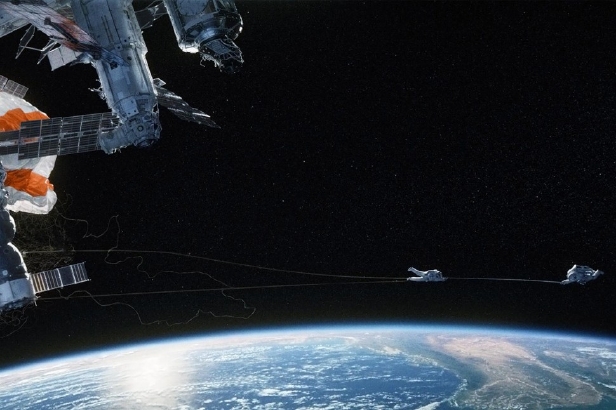
Huh. I recall my friends citing articles from popular publications where astronauts supposedly praised Gravity for its utter phycics realism. I disagree with you about Gravity (I didn't like it very much) but I agree that in the great scheme of things realism isn't that important for entertainment.
I can't imagine an astronaut praising the "physics realism" of the "buffeted by the wind in space" moment that caused the death of the male character. His momentum had clearly been completely stopped by the tether, but instead of rebounding back toward the other tethered astronaut (as had happened multiple, more realistic, times earlier in the movie), some unknown force kept pulling him away until at last the tether came loose. If the setting were terrestrial the force would be inferred by most viewers to be the drag of a moving fluid such as wind. What similar force exists in space?
I don't complain about the presence of unrealistic space plot device in unrealistic space movie, but there it is.
Bullock's leg was entangled with the parachute cords, and holding on to Clooney's tether with one hand. The Bullock-Clooney system was inertially travelling away from the ISS, to which one end of the parachute lines was anchored. The tangle of parachute cords was straightening as the distance increased. Eventually, they will run out of slack, at which point there will be an impact which (in Clooney's opinion) would either cause Bullock to lose her grip on the tether (dooming Clooney) or cause the cord looped around her foot to slip free (dooming them both). Bullock is barely connected to anything, has only one hand free (at best), and is in a terrible emotional state, rendering her incapable of useful action.
Clooney throws off his tether which causes three things to happen:
1. A small amount of seperating momentum to both Clooney and Bullock, pushing Clooney further away and slowing Bullock towards the ISS.
2. Halving the force needed to stop Bullock's movement away from the ISS.
3. Freeing up Bullock's hands to improve her attachement to the parachute cord.
I have no idea if the math works out but I don't see the theoretical problem with the situation physics-wise.
I think the parachute cord is already taut when this scene takes place (see 1:08 at http://www.youtube.com/watch?v=AjLcIxcSaik), so I don't see how it can run out of slack beyond this. And in your version, where does the tension in the tether between Bullock and Clooney come from?
When I saw the scene, I imagined the cord and/or the parachute to be elastic. So even if the cord is taut, it may not be in a stable stationary state; the cord might snap beyond a certain amount of stress or the parachute might unhinge.
Infact, after Clooney's character unleashes himself, Bullock's character recoils back, which seems to agree with my elastic theory.
A realistic solution would be for them to be rotating which pulls the line taught and when released he would seemingly fall. However, I don't think that's shown in the actual visuals as they would have to be rotating fairly quickly or the cord needs to be really long for that to be a significant issue.
Anyway, just looking at the previews I saw a enough holywood physics to give the thing a pass. The way the ISS was destroyed looked cool but the physics was terrible.
They are shown rotating slowly, so it's sort of possible given an elastic parachute cord, but it's awfully contrived. You also have to wonder, given how slowly he drifted off, why Matt couldn't unstrap that empty thrust pack and use it as reaction mass, as Ryan does with the empty fire extinguisher later on.
The bigger gaffe for me was Matt's instruction to Ryan, right after the first hit, to detach from the arm on the grounds that it would carry her too far away. That makes no sense at all. Detaching won't affect her velocity except to add a sizable random component based on the point in the arm's rotation where she detaches, and since he's already lost sight of her at that point that's going to make her much, much harder to find.
All pedantry aside, loved loved loved the movie. Certainly the film of the year for me, and possibly the decade.
Some people can't stand bad acting, I hate bad physics. I think it's the same basic issue. When a movie shows something that's close but off it simply breaks the suspension of disbelief. It's probably got something to do with the uncanny valley where talking stick figures don't cause problems, but the more realistic the setting the less wiggle room you have.
I suspect most people have similar pet peeves. I remember watching a action movie with an ER doctor once. They had the same sort of reaction but with the long list of injury's people would end up with. Or how many tech people get offended by computer techno-babel in movies.
> I don't complain about the presence of unrealistic space plot device in unrealistic space movie, but there it is.
Normally neither do I, except if the movie's marketing made it an issue. I never actually researched realism claims about the movie (as I said, it came up during a discussion with friends, two of whom cited two different articles where astronauts had testified as to the accuracy of the movie's physics) until now. I have to say that claims of realism are in fact mostly confined to headline writers and journalists quoting astronauts out of context, for example when an astronaut referred to "stunning realism" of the special effects, that got mangled into "astronaut praises stunning realism of Gravity".
Reading the actual reviews, I still believe that misleading claims were made, but apparently experts were mostly quoted creatively.
It's been some time since I've seen it, so you may be right. However, the situation you describe would only obtain once the entire system was rotating. As I recall, the female astronaut grabbed onto the object and the tether immediately stretched out tight, with no time to impart angular momentum to the tether or to the male astronaut. In that situation, I would expect the tether to wind around the object somewhat in the interim before the male came loose, and in that case he would have been imparted with some lateral momentum that would have taken him past the object (although not necessarily within retrieval distance) rather than straight away from it as I dimly recall from the film.
It was not in any way portrayed as rotating. In fact Sandra's character seemed to be moving away from the ISS at a snail's pace. Furthermore, she was neither accelerating nor decelerating. It was poorly portrayed, that's why there is disagreement. As portrayed visually, it doesn't make sense. This was done I assume to stretch out the dramatic moment of decision so they could have an actual conversation about it. Even then that could have been achieved simply by having the conversation happen while the two were moving away from the ISS much faster.
Hahaha looking at the picture I realize there is no way the "object", let alone the tether and astronaut, could be rotating fast enough to create such a force.
Aside from the thing that jessaustin mentioned, there's also the problem that Hubble and the ISS have completely different orbits and that you can't just take your back mounted whatever-it-is-called and fly between them.