This is very useful information and comes at a perfect time! I use Openrouter for my newly released running tracker (I use it for live coaching and post-run debriefs). I've benchmarked a bunch of models over time to evaluate their aptitude for this specific task, and have noticed that sometimes a model can underperform for seemingly no reason. I'll be sure to include model providers in my benchmarking suite going forward!
I've been fascinated by Cephalopods since reading (the excellent) book "Other Minds" by Peter Godfrey-Smith. They are probably the closest we'll get to an alien intelligence. Their nervous systems evolved along a completely different evolutionary path from us vertebrates. It pains me that they are so short lived, though. I wonder what potential could be unlocked by their intelligence if they lived for 40 years or longer.
You just need to convice the ethics review board on some research lab to allow for editing the genes of a few octopus to make them longer lived, give them education, etc...
This is only tangentially directed at your reply, but this is the kind of statement that I'll sometimes hear other parents say, and it makes me think that they've completely forgotten what childhood was actually like. Like, the idea that normal, fun activities and sports are bad because they bear some abstract resemblance to adult violence feels very contrived and misses what childhood play is about.
Yeah I'm not saying it's bad for the children, but it's unpleasant for me. It seems violence is a concept that gets deeper and uglier as you grow. For young children it's often abstract and maybe harmless. I just read a book to my child that turned out to have violent scenes that horrified me a bit but he barely thought about it and only in technical terms (like where is that artery ripped by the wolf). Same with people that had fun watching horror movies as teens, then find them unpleasant when they're older.
Maybe they did not forgot what the childhood was like. Instead, they remember their own childhood rather then yours. Moreover, they are not you, your exact copies.
It's not really that abstract. You smash the shit out of a cardboard box and candy comes out. Breaking things is not fun. I also hate youtube videos of people breaking stuff for fun.
I don't know. I broke a lot of things when I was a kid, mostly because I was excited to see how they work, but have no knowledge of their value or how to safely disassemble them. I don't do it as an adult because I now have that knowledge. So don't judge a kid as an adult.
I tried reading the English Wikipedia article "Piñata" but it is a mess of cringe information, especially the 16th century background. It seems that original piñatas were clay pots, before papier-mâché came into vogue.
I was going to say, that around the American Southwest, you can find piñatas for sale that are not only abstract, but also plenty of Spongebob and Disney and MCU characters, as well as "political figures that are not particularly well-liked" by Chicanos.
Me and my partner did this as well, only using a HTC Vive. We modeled our bathroom in two different versions and could toggle between the two while "standing inside" the bathroom. The VR simulation was the deciding factor between the two layouts, as one just "felt" better in person.
Do you recommend an application in particular to make it easy to do something like that (record a video walk through that you turn into a rendering on a PC in VR)? I happen to have a Valve Index with dust on it.
And I mean for someone with no specialized architect/design skills.
Speaking of which, it seems like evolution in the headset world is slow or stalled at least commercially.
Thanks for linking that comment! I wasn't familiar with the term, but it perfectly describes the pattern that manifests in every single HN thread about certain topics. The Grok announcement thread that is on the main page today is another perfect example.
We had much of the same skepticism and anti-EV propaganda here in Norway a decade ago, when EV's started becoming popular. The usual claims was that the batteries would have to be replaced every five years, the cars would stop working in the winters, the batteries are fire hazards, the power grid won't support everyone buying EV's, etc.. All of which turned out to not be true.
Today the market share for EV's is 98% and they account for the majority of the total number of cars on the road! The people who bough 1st. generation EV's as a number two car a decade ago chose EV's as their main car before long. My own vehicles are 7 and 12 years old and holding up well, despite the 12 year old having inferior battery chemistry compared to modern cars.
Change isn't always easy or smooth, but this one is inevitable.
98% of NEW EVs. But the total market share of the fleet is about 1/3. Impressive. If EV share is 90% in a decade I wonder if Norway will see fuel stations being torn down.
Yeah, it's amazing how fast the transition has been. Many gas stations are or have already reallocated space from gas pumps to charging stations, and new stations are designed to accommodate EV's. Take a look at this station as an example - it's already five years old at this point: https://tinyurl.com/4y8u36m2
I should have been more accurate in my "majority" claim; it refers to EV's being the most common type of car compared to gas or diesel. Source: https://tinyurl.com/ycke45dy
I'd imagine trucks would still be diesel, so it'd probably make sense just to remove some of the pumps and replace them with rapid chargers. I doubt the fuel stations themselves will disappear, just cater to a different market.
OTOH in the UK at least, I think public charging is way too expensive compared to home charging, so I think most public charging is done out of necessity on long journeys, so the number of people using chargers would probably be significantly lower than number of people filling up with fuel.
Electric semi trucks have appeared from all major European manufacturers in the last years and I expect them to become dominant even quicker than electric cars on simple cost grounds. Electricity is cheaper than diesel and due to favorable regulations in Europe, for many use cases there is little to no time lost charging and usually also no loss in load capacity.
According to YouTuber Bjorn Nyland, some such as Circle-K had already installed charging stations and are now removing some pumps and replacing them with chargers while adding even more charging stalls.
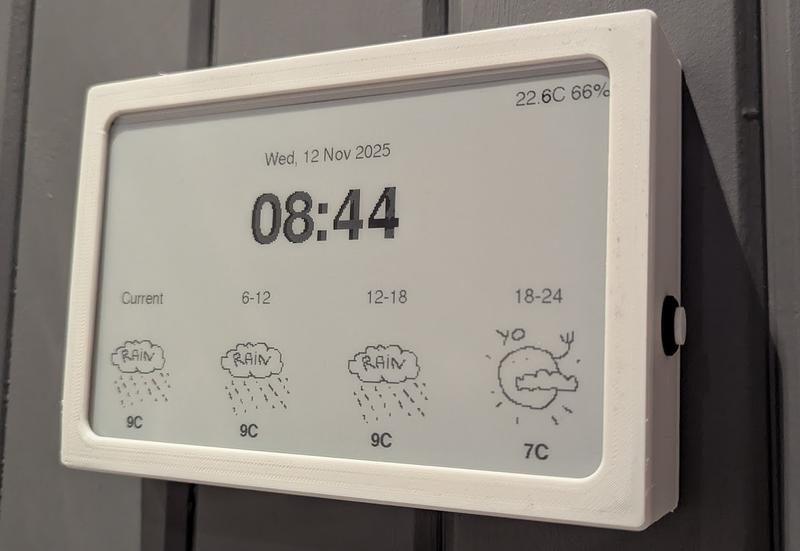
I made this thing [1] for us, it uses a cheap 10" e-paper display off aliexpress, an ESP32 and a couple of I2C sensors. The case is 3D-printed. It runs on two 18650 batteries, and all in all it cost less than 100$. The OpenWeather API is free for personal use.
Thanks! I intentionaly made the weather symbols somewhat "childlike" to give it some personality and also make it obvious that it's a custom device, and not some off the shelf gadget. Works well as a conversation starter!
The sun is greeting you! I drew these freehand, kind of quickly. And while I personally like the style and think it's a good fit for us, I did intend to make several sets of weather icons. At the very least I need to make the sun symbols adapt to the seasons - we don't really have a full sun during the darkest months of the year where I live.
I incorporated OpenMeteo into a project recently and got frustrated with their aggressive rate limiting. If in the US, weather dot gov has an excellent, free API. Or, OpenWeatherAPI which works internationally and has support for more things that weather dot gov does not. OpenWeatherAPI will also synthetically provide weather data based on their models if there is missing station data
> I incorporated OpenMeteo into a project recently and got frustrated with their aggressive rate limiting
Which one? They seem to do 600 calls / min, 5.000 calls / hour, 10.000 calls / day, 300.000 calls / month, how many times do you need to look up the weather for personal use? Fine, maybe you want 3 different locations, you can still call each of those sufficiently with those rate limits, no?
Right, but less "I want to know what the weather is locally and maybe in my summer house" and more "I'm curious about sampling global weather/temperatures", right? I don't think the intention of the API is for the latter, but more for the former.
a redis geospatial index + redis distribution locks you can build a performant cache layer that is consumed by a ton of people and stay well under that rate limit.... the weather data only updates every 5 minutes too, so you can use that for your cache ttl.
Yes, I think so. Electronics prototyping is so accessible now, and there's such a deluge of inspirational projects out there to learn from. YouTube is a gold mine, and I'll leave links to a few channels I follow, below.
If you get an Arduino or Esp32 microcontroller (maybe in one of those starter-kits with various sensors), some breadboards, assorted jumper-cables and a kit with electronic components (resistors, caps) you'll be good to go. A device like a wall clock most likely won't require soldering, since it won't be jostled or moved around much.
If you already have Home Assistant running, I think it should be simple. Most of the time you can buy devices with pins already soldered and it's just the matter of connecting them together. AIs are pretty good with ESPHome configs. You can even take a picture so that they can help you identify the correct pins. Some coding may be required for drawing things on the display though.
+1, and have you tried running 2 displays side by side ? That should give you an effective diagonal of 14 inches or so, and for those displays, cutting it in two does not really affect the utility of the display (likely tabular content anyway).
Seems like the author has experimented with 2 kindles side by side.
I source most of my components from aliexpress. It's been a while, but these are the components I used:
Microcontroller: FireBeetle 2 ESP32
Display: Generic 10" e-Paper display with driver board included
Timekeeping: DS3231 Real Time Clock Module
Temperature and humidity: BME280 module
Charging: Type-C USB 2S Li-ion BMS
That, along with a breadboard, two 18650 batteries, some resistors and capacitors make up the hardware. I modelled and 3D printed the case. I used the PlatformIO plugin (available for VSCode-based IDEs) for programming and transferring code to the esp32.
I used to play GTA on my 133 mhz Pentium, running windows 95. I distinctly remember the game running smooth and at a reasonably high resolution! My memory must have betrayed me because playing this now is hard to stomach. I just can't get over the jaggy motion of the hardlocked framerate (especially while driving at high speeds).
I played GTA III at like 14-16 fps. After a while you brain get used to it and feels a like a smooth experience. Maybe we have frame generation integrated in our brains? or just happens when we are kids? idk.


reply